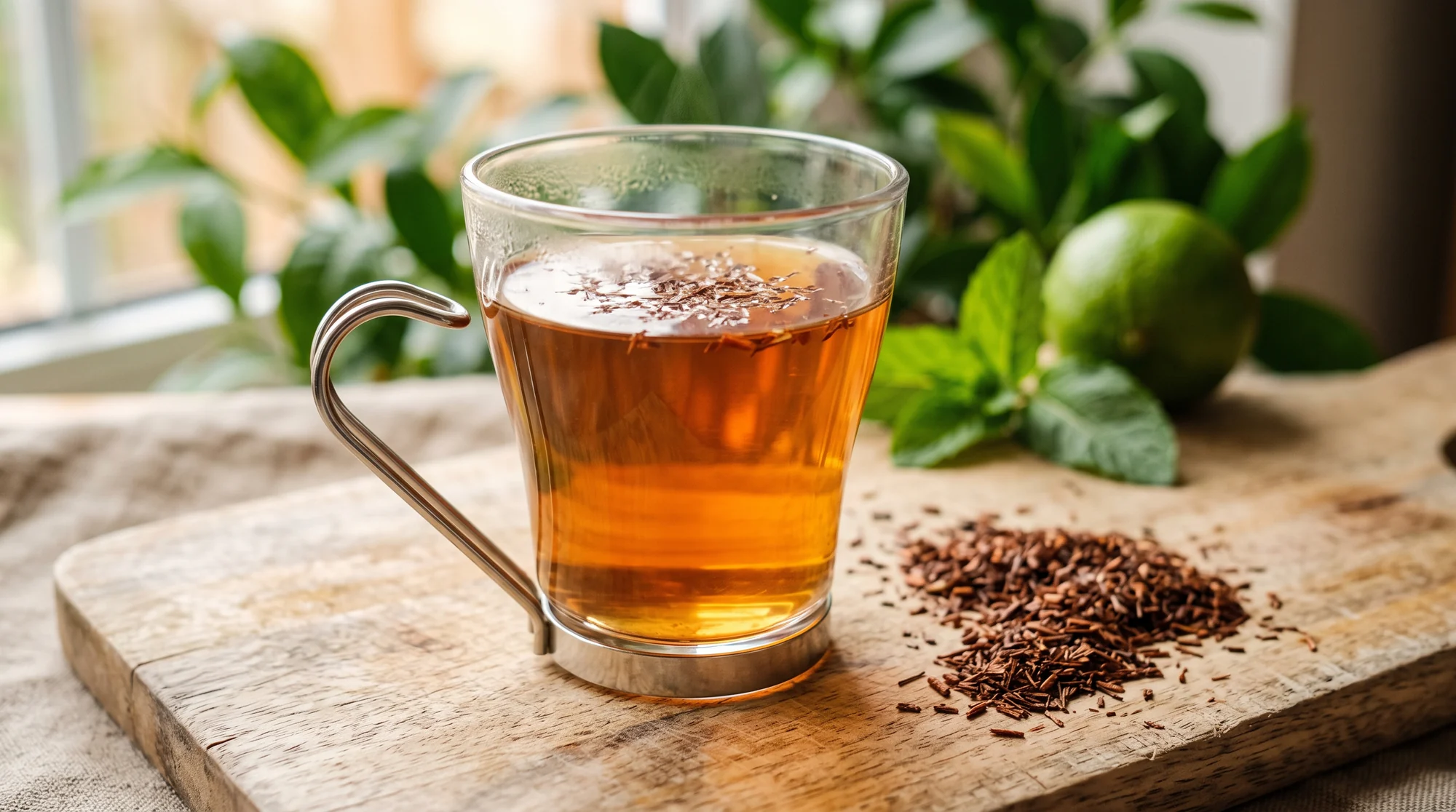
Advertising content. Neither the infusion nor the powder is a medicine. See all warnings.
These statements have not been evaluated by the Food and Drug Administration. This product is not intended to diagnose, treat, cure or prevent any disease.
Advertising content · For adults 18+ · Individual results vary and are not guaranteed · Consult your physician before use.
The first half
Can you drink Vicks VapoRub? No — and here is the mug people actually mean
It comes up every winter, and it has been coming up more than usual lately: videos and posts showing a spoon of Vicks VapoRub melted into hot water, or a few drops of eucalyptus oil stirred into tea, presented as an old family remedy. People search for it because they half remember something like it from childhood.
What they are half remembering is almost certainly not that. It is the lemon and honey mug that came with it — the one you were handed while the ointment went on your chest. That drink is worth keeping. The ointment in the mug never was, and the reason is on the tub.
You will see it called “Vicks tea” — a spoonful of VapoRub stirred into a mug of hot water. Most people doing it are after the steam, and leaning over the bowl with a towel is the version their mother actually used. Drinking it is a different matter: the tub says for external use only, and that line is worth taking literally.
Which leaves an easy conclusion. Everything good about that mug — the heat, the steam, the sharp clean smell coming up at your face — comes from things that are simply food. A lemon, a piece of ginger, a sprig of rosemary, a few mint leaves. You get the pleasant part, from the supermarket, with nothing on the label telling you not to.

Six things, all from the supermarket
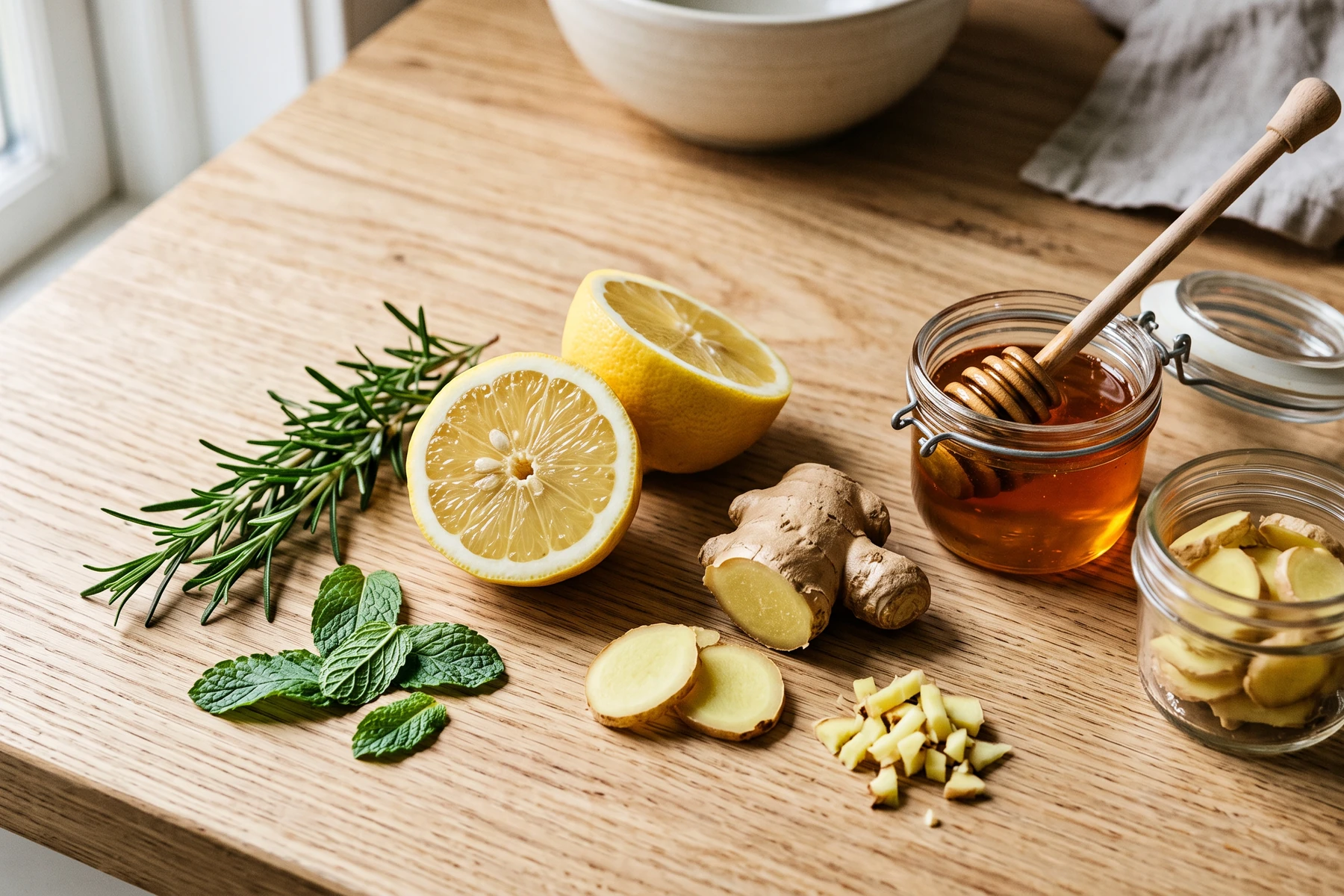
A lemon, a knob of ginger, a sprig of rosemary, a few mint leaves, a jar of honey and hot water. The lemon and the ginger together come to about a dollar and make four or five mugs; a rosemary plant on a windowsill costs a few dollars once and then keeps going. The honey lasts months.
Nothing here is exotic and nothing here is a medicine. It is a warm drink that tastes good, wakes you up, and gives the morning a shape — which turns out to be the part that decides whether a routine survives past week two.
Why these are in the mug, honestly
A page like this usually claims the drink does something. This one will not, because none of these is a treatment for anything. But they are not in the mug at random either, and it is worth saying which parts have something behind them and which are simply there because they taste good.
Rosemary — the one with a story and a study
“There’s rosemary, that’s for remembrance,” Ophelia says in Hamlet. The association is four hundred years old and older than that in folk use, which is usually where the story stops.
It did not stop there, and it is worth separating two different studies that often get told as one. In the first, Mark Moss and Lorraine Oliver at Northumbria University exposed 20 adults to rosemary aroma and took blood samples [1]. Levels of 1,8-cineole — a compound that crosses from the air into the bloodstream — tracked with how well people did on cognitive tasks. In a separate study, Moss and Jemma McCready sat 66 people in a rosemary-scented room or an unscented one and tested prospective memory, remembering to do a thing later; the rosemary group did better [2]. No blood was taken in that one.
Read that carefully, because the detail matters: it was the smell, in healthy adults, in small studies — 20 people in one, 66 in the other. The researchers said themselves that more work is needed before it can be extended to older adults who have already noticed decline. Nobody proved anything about drinking it.
Which is exactly why it belongs in a hot mug. Steam carries the smell up at you every time you lift it — the same route the study used. Bruise the sprig before the water goes in.
Peppermint — for anyone who misses the menthol
If what you liked about the old mug was the cold, clean, menthol edge, this is where you get it back — from a leaf, out of the salad aisle, with nothing on the label warning you off.
It also happens to be the ingredient here with the most direct evidence, and unusually it was tested as a drink rather than a smell. The same Northumbria group ran 180 people through three arms — peppermint tea, chamomile tea, or plain hot water — and tested them afterwards [3]. Peppermint came out ahead of both on long-term memory, working memory and alertness. Chamomile went the other way and slowed people down, which is roughly what you would expect of it.
The honest footnotes: healthy adults, a single sitting, and a single study published in Plant Science Today rather than a decades-deep literature. It is one good study, not a settled fact. But it is a real one, it was about drinking the stuff, and it costs about thirty cents to try.
Add a small handful of fresh leaves at the end, off the heat, with the honey. Boiling water strips the menthol straight out of them, which is why supermarket mint tea so often tastes of nothing.
Lemon — vitamin C, and where it goes
Half a lemon carries a useful amount of vitamin C. The part people do not know: the brain holds one of the highest concentrations of vitamin C of any organ in the body — it is actively pumped in and kept there, with neuronal levels reported up to 10 mM [4]. That is plain physiology, not a claim about this drink.
Half a lemon will not transform anyone. It is simply a real nutrient in a drink you were going to make anyway, which is more than most warm drinks can say.
Ginger — here for the warmth, and we will say so
Ginger has good evidence for nausea and a long record for digestion. For memory, the honest answer is that the research is thin and mostly small. It is in the mug because it makes it taste like something rather than hot lemon water, and because the heat in the back of the throat is what wakes you up.
We could have dressed that up. It would have been the first lie on the page.
Honey — mostly sugar, and that is the point
Honey is sugar with a little else in it. Darker honeys carry more polyphenols than pale ones, which is true and also a small effect at one teaspoon. Anyone selling you honey as a brain food is selling you sugar.
Its real job is that it makes the drink good enough to want tomorrow. A routine you abandon in week two does nothing at all, so the ingredient that keeps you coming back is doing more work than it looks like. One teaspoon, stirred in at the end.
The hot water — the least interesting and the most necessary
Mild dehydration measurably affects concentration and mood, and most people wake up mildly dehydrated after seven hours without a drink. A large mug first thing is the cheapest thing on this page and probably the one you would miss most.
Rosemary leaves, never rosemary oil. The sprig from the supermarket is food and has been for centuries. Rosemary essential oil is a different thing entirely — concentrated, and meant for the air rather than the mug. The study above diffused it into a room; nobody drank it. Use the sprig.
Which honey to buy: the two that work
This is the one ingredient where the shelf is misleading, so it is worth thirty seconds.
What to skip: honey-flavoured syrups and squeezy bottles blended with glucose syrup. Turn the bottle around — if the list has more than one line, put it back and take the jar beside it.
The two mistakes that ruin it
Boiling water on the lemon. Squeeze the lemon into water that has stood a minute off the boil, not into water that is still bubbling. Straight from the kettle the juice turns flat and slightly bitter. A minute of patience is the whole difference between this tasting bright and tasting like dishwater.
Honey too early. Stir the honey in at the end, once the mug is warm rather than scalding. Very hot water thins the flavour out of it, and you end up using twice as much for the same taste. Honey last, always.
The recipe
Lemon, ginger, rosemary, mint and honey — one mug, four minutes
Nothing is measured very carefully. It is a mug of tea, not a formula.
- — half a lemon, juiced — plus a strip of the peel if you like it sharper
- — a thumb of fresh ginger, in thin slices, skin on
- — a teaspoon of honey, to taste
- — 300 ml hot water, just off the boil
- — a short sprig of fresh rosemary — the leaves, never the oil
- — a small handful of fresh mint leaves
- — optional: a cinnamon stick or two cloves
1. Put the ginger slices and the rosemary sprig in the mug. Pour the hot water over and leave it three or four minutes. Bruise the rosemary between your fingers first — that is what releases the smell, and the smell is not incidental here.
2. Squeeze the lemon in. Off the boil, never into water that is still rolling.
3. Wait until you can hold the mug comfortably, then drop the mint leaves in and stir the honey through. Both go in off the heat — boiling water flattens the mint and thins the honey.
4. Leave the ginger in while you drink. It keeps getting better and you can top the mug up once with more hot water.
Make it once, drink it three times. Slice a whole thumb of ginger on Sunday and keep it in a jar in the fridge. Some people go further and pack a jar with sliced lemon and cover it with honey — it keeps for weeks in the fridge and a spoonful of it is the whole drink in one go.
Three honest notes
- Never give honey to a baby under twelve months. It carries a real risk of infant botulism. Above one year it is fine.
- Lemon is acidic. Rinse your mouth with plain water afterwards and give it half an hour before brushing — brushing straight after acid is what wears enamel.
- Ginger in ordinary kitchen amounts suits most people, but if you take blood thinners or are due for surgery, mention it to your doctor. It is a small thing and worth saying out loud.
The second half of the morning
And the glass: what we take
The mug is the half that costs pennies and works this morning. The second half is the slow one, and it is not something you find in the supermarket — it is a powder sold online. Since this page is advertising, we say so plainly, and then tell you what is in it, how it is taken alongside the mug, and what it costs.
Powder — one scoop a day
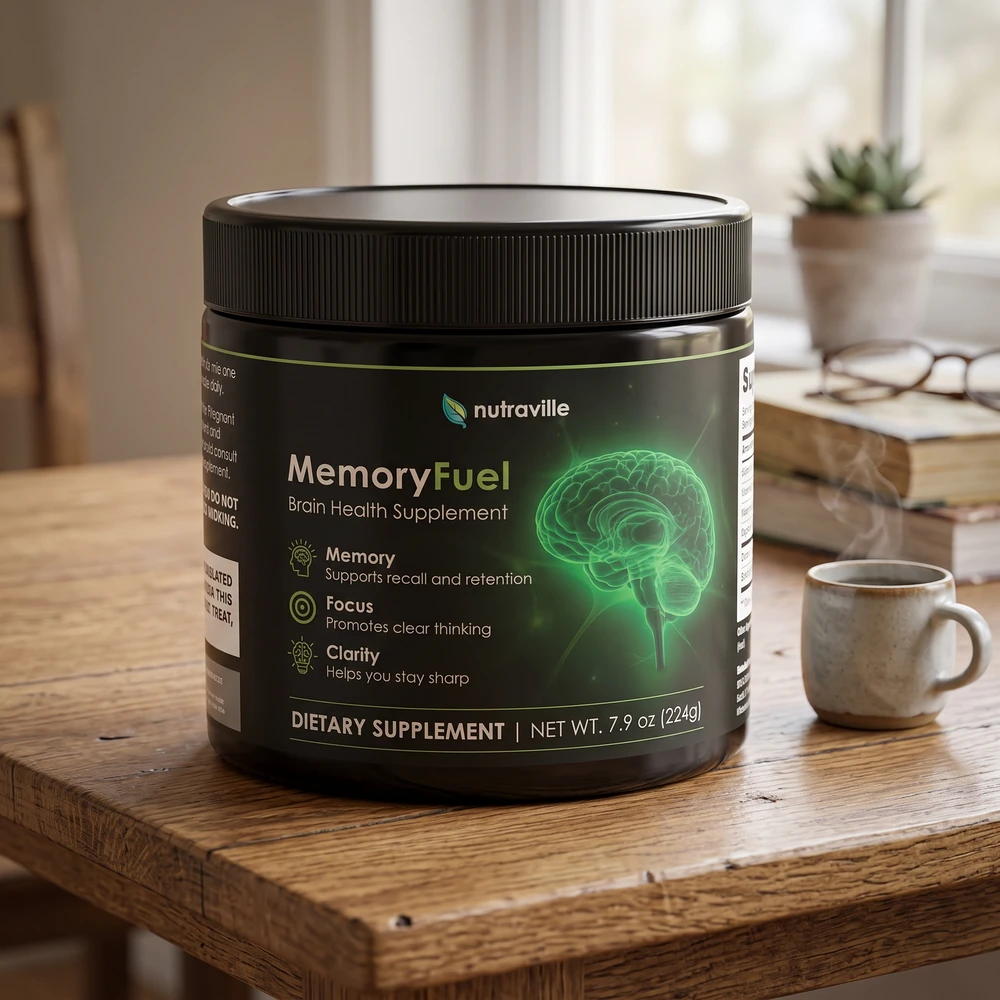
MemoryFuel
One scoop stirred into a plain glass of water, once a day. Six ingredients, none of them exotic: creatine, L-theanine, choline, magnesium, vitamin D3 and vitamin B12. The label says to take it with a meal, which is convenient — by that point the kettle has boiled and breakfast is in front of you.
See the productThese statements have not been evaluated by the Food and Drug Administration. This product is not intended to diagnose, treat, cure or prevent any disease. For adults 18+.
What is inside
Six things. Here is what each one actually is, in plain terms.
Creatine monohydrate — the most heavily studied supplement there is, mostly in sport. Research on memory and thinking is more recent and less settled, and the honest summary is that it looks promising rather than proven. It also works by building up: taken daily it takes weeks, not one morning.
L-theanine — the amino acid that occurs naturally in tea leaves. It is the reason a cup of tea feels steadier than the same caffeine in coffee.
Choline bitartrate — choline is a nutrient your body uses to make acetylcholine. Egg yolks and liver are the food sources most people never quite eat enough of.
Magnesium glycinate — magnesium bound to glycine. The form chosen when a maker wants it absorbed well and gentle on the stomach, rather than the cheap oxide form.
Vitamin D3 and vitamin B12 — these two only do something if you are short of them. That is not a criticism; plenty of people over sixty are short of both, particularly through winter.
Where to check the amounts: the sales page lists the six ingredients without the milligrams beside them, which is worth knowing before you decide. The full Supplement Facts panel is published separately, as a photograph of the label — you can read it here. Two minutes with that panel tells you more than any page about the product, including this one. Do that before you buy anything, here or anywhere.
Forgetting names is not the same as losing your memory
Worth separating, because the two get sold as one thing. Walking into a room and forgetting why, losing a name for ten seconds, misplacing keys — that is ordinary, it happens at thirty as well as at seventy, and it gets worse with bad sleep and a loud week.
Memory that is getting steadily worse, repeating the same question within an hour, getting lost on a familiar route, struggling with words mid-sentence — that is a different thing, and it belongs in front of a doctor, not a supplement. This page is a breakfast routine. It is not a treatment for anything. One more reason to go: low vitamin B12 genuinely does cause memory problems, and it shows up on an ordinary blood test.
The morning glass
One scoop in a plain glass of water, once a day, with food. We stir it while the ginger and rosemary are steeping: by the time the mug is cool enough to hold, the glass is ready and the two go down one after the other.
Creatine also pulls a little water with it, so this is not the morning to skip drinking. The mug covers most of that on its own, which is one of the reasons the pair works.
Taking both
They work on two different clocks
This is the part that makes the pair worth bothering with, and it is easy to miss. Look at what those two studies actually measured: people were tested that same sitting. The rosemary and the peppermint did whatever they did within the hour. Whatever you get from the mug, you get this morning, and it is gone by lunch.
Creatine is the opposite. It works by building up in tissue over weeks of consistent daily use — there is nothing to feel on day one, and anything you notice is somewhere out around week four. One of these is for this morning. The other is for March.
That is why they sit on the same tray rather than competing. The mug is the part with an immediate payoff, which is exactly what a habit needs to survive its second week — and by surviving, it drags the slow one along with it. Nobody abandons a routine because of the price. They abandon it because on day nine there was no reason to remember. Boiling the kettle is that reason. The glass goes beside the mug because the kettle was already on.
The mug also handles the water. Creatine draws water with it, and 300 ml of lemon and ginger covers most of what the powder asks for before you have thought about it.
One thing not to do: never tip the scoop into the mug. It is the obvious move — the mug is right there, it is already a drink. But creatine in solution slowly converts into creatinine, which does nothing for you, and two things speed that up: heat and acid. As a rough rule the reaction roughly doubles for every 10 °C, and it runs faster the more acidic the liquid gets.
A mug of hot water with half a lemon squeezed into it is both of those at once. It is close to the worst glass of liquid in your kitchen to put creatine in. Plain water, in a separate glass, drunk reasonably soon after stirring — that is all it needs, and it costs nothing to do it that way.
So: scoop in the glass, lemon in the mug, both on the same tray. One after the other, while breakfast is in front of you.
The five minutes, start to finish
Written out as one thing, because that is how it actually happens. One of the five minutes is spent waiting.
What the morning costs, honestly: the mug lands somewhere around a quarter. The scoop is $1.63 a day on the six-bottle pack, $1.97 on the three, and $2.63 on a single bottle with shipping. That is the whole routine — and the cheap half is the one you feel today.
Before you buy
- This is a dietary supplement, not a medicine. It is not intended to diagnose, treat, cure or prevent any disease.
- Memory that is getting worse over months belongs in front of a doctor. No supplement is a substitute for that appointment, and some causes are treatable.
- If you have kidney disease or are on medication that affects the kidneys, ask your doctor before taking creatine.
- If you take any prescription medicine, are pregnant or nursing, speak to your doctor or pharmacist first.
- Drink water through the day. Creatine draws water with it.
- Keep out of reach of young children.
References
Every study mentioned on this page, with a direct link so you can read it yourself rather than take our word for it.
- Moss M, Oliver L. Plasma 1,8-cineole correlates with cognitive performance following exposure to rosemary essential oil aroma. Therapeutic Advances in Psychopharmacology. 2012;2(3):103–113. doi:10.1177/2045125312436573 — 20 healthy adults.
- Moss M, McCready J. Rosemary aroma and prospective memory. Presented at the British Psychological Society Annual Conference, 2013 — 66 healthy adults. Northumbria University release. Conference presentation, not a peer-reviewed paper.
- Moss M, Jones R, Moss L, Cutter R, Wesnes K. Acute consumption of Peppermint and Chamomile teas produce contrasting effects on cognition and mood in healthy young adults. Plant Science Today. 2016;3(3):327–336. doi:10.14719/pst.2016.3.3.246 — 180 adults.
- Travica N, Ried K, Sali A, Scholey A, Hudson I, Pipingas A. Vitamin C Status and Cognitive Function: A Systematic Review. Nutrients. 2017;9(9):960. doi:10.3390/nu9090960
These studies were conducted on the individual plants named, not on MemoryFuel, and none of them tested this product. They are cited to show where the traditional associations do and do not have research behind them.
Price, shipping and guarantee
One bottle is a scoop a day for thirty days, and it is sold on its own or in packs of three and six. The bigger the pack, the lower the price per bottle — and since nothing here works in a week, the smallest one is the most expensive way to find out.
Guarantee: the seller offers a 90-day money-back guarantee — if you are not satisfied, you can ask for a full refund within ninety days of purchase, under the conditions set out in its own terms. Ninety days matters more than usual here, because a daily supplement that works by building up cannot be judged in a week.
These statements have not been evaluated by the Food and Drug Administration. This product is not intended to diagnose, treat, cure or prevent any disease. For adults 18+.